


 tkkim@hotmail.com


Proud Member of :

Canadian Kendo Federation



Interesting Links
Media & Trivia
How to become a member of Shidokan ?
Where is the dojo?
Our main location is at Concordia University Loyola - Campus.
Before registering, please read our code of conduct and rules. Registration & feesThere are fees for students and for public in general so everyone can join Shidokan. Registration for the Winter 2024 Session is now closed. |
 |
FAQ (Frequently asked questions)
May I watch the practice before joining?-
Yes. Visitors are welcome to observe at any practice. There are no fees and there's no need to let us know in advance.
Experienced practicioners from other clubs are welcome to join our practice at any time.
- During the first week of training (Kendo and Iaido) you may come and try our practice to see if it's what you are looking for without registering. Shidokan is a non-profit organization, the fees are intended to cover the rental and maintenance of our facilities.
- We believe Kendo and Iaido are benefitial for everybody. However, if you are looking for 'just a hobby' , perhaps a serious martial art (such as Kendo or Iaido) is not your best alternative. Our goal is to cultivate our minds and spirits, through a lifetime journey of diligent training.
- It's not mandatory to attend to every kendo class, Although for the student's progress we recommend to attend as many times as possible. If the student can attend only once per week, we would suggest some 'homework' drills to complement his/her training.
-
Kendo and Iaido lessons are offered at our main location: Concordia University (Loyola Campus main gym) in Notre-Dame-de-Grâce (Montreal).
Some of our Shidokan senior instructors offer training in other parts of the Greater Montreal area as well. Please visit our contact page for more information.
-
Kendo and Iaido are very much related. They share a common root.
The majority of high ranking kendoka practice iaido, and vice versa.
In the beginning it does not matter which one you start with.
Many of our club members, although still inexperienced, practice both.
We find one complements the other and help in the understanding of both.
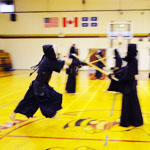
* Kendo is the sparring part of Japanese swordmanship. You will train in full contact with your oponent.
* Iaido is the sword manipulation part of Japanese swordmanship. We learn a set of forms (kata), practiced alone against imaginary opponents, and repeat over and over again. At the very begining we use a simple wooden sword (bokuto) and then as we progress we use an unsharpened imitation sword (iaito). We learn how to hold, draw, cut, clean, resheath, etc. High ranking students may use a real sharpened sword (Only 3rd Dan and up with Sensei's permission).
- Loose fitting sweats or a track suit are fine. Judo or Karate uniforms also work well if you have them. For safety reasons, jewellery should not be worn.
-
Yes. You will need a bamboo sword (shinai) for Kendo and a wooden replica sword (Bokuto or bokken) for Iaido. It is advised to purchase your own in advance.
* It's recomended for Iaido student to get a pair of Knee pads since many of the Kata (form) start from seiza (sitting on your knees)
* Iaido students are advised to get a Iaito (unsharpened sword imitation) to be able to practice acurately every movement.
-
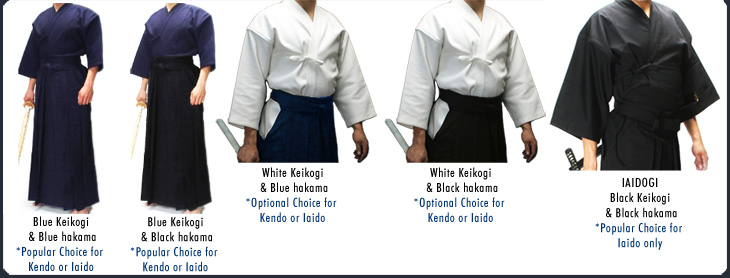
You can buy the kendo uniform (Keikogi and Hakama) after you've decided you're going to stick with it. You won't be permitted to wear armor (bogu) until you've been practicing for six months to a year, depending on ability and practice frequency.
For Iaido your Kendogi and hakama can be used as well. If prefered you may also purchase a IaidoGi (usually in full black)
 Where can I buy equipment?
- Shinai are generally available through the club. Uniforms, bokuto (bokken) and armour (bogu) are generally purchased on-line by the members themselves. Some equipment suppliers are listed on the suppliers page. The club's instructors can recommend other reputable suppliers.
-
A basic bamboo shinai generally costs around $40 (plus shipping) and should last a beginner 8 to 12 months. A basic wooden Bokken will cost $50-$70 (plus shipping) and will last forever. A good quality KendoGi (uniform) can start at $70. Good quality Bogu (Armor) start at $500.
* At the begining of your training you will only need a shinai and lots of patience. (Kendo)
* At the begining of your training you will only need a bokuto, knee pads and lots of patience. (Iaido)
- A limited number of sets of armour (bogu) are owned by the club. They are available for loan to our members for a small fee. Each student is expected to have their own shinai and/or bokuto.
- For the first six to eight months you will learn warm up exercises, footwork, how to swing the sword properly, and execute basic strikes. This is done under the close supervision of an instructor or senior member. You may practice striking senior members wearing armour, but you will not be struck yourself. For the most part, a shinai held at head or wrist level will be used as a target to practice the basic strikes. Kendo is done in bare feet, and you will likely get blisters at some point. There is little aerobic exercise value in Kendo at this stage. Before you can participate in full contact sparring, you need to have the basics down cold.
- After the first six to eight months you will put on armour and practice the strikes and thrusts in full contact practice with an opponent. The first half of practice will typically be drills, often finished up with intense aerobic conditioning drills. The second half typically consists of free practice sparring with other (more advanced) members of the club.
