


 tkkim@hotmail.com


Proud Member of :

Canadian Kendo Federation


Interesting Links
Media & Trivia
The Kendo Equipment
The equipment used for Kendo practice are the bamboo sword (Shinai) and a set of protective armor (Bogu). The bamboo sword is made of four carefully prepared staves or pieces of bamboo that are fitted and held together at both ends by a leather handle, tip, and special string designed to designate the back of the sword.
How to put the bogu on
Tenugui |
Wear the bogu |
|
Bōgu (防具)
Bōgu (防具) is specially developed protective armour used in Japanese martial arts, kendo and naginata.
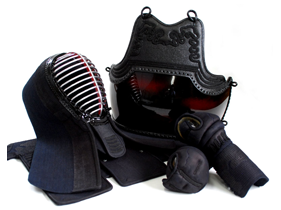
The Bogu is the protective armor worn by Kendoka during training and tournaments. The Bogu is worn over clothing which is comprised of the Keikogi (shirt) and Hakama (traditional pants). A traditional Cotton Wrap called the Tenugui is worn under the Men to provide a base for the Men to fit Comfortably.
|
 |
MEN (面 ,めん) Facemask and shoulder protector
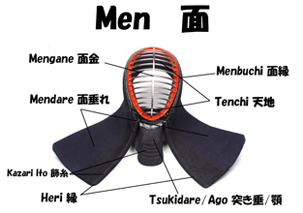 |
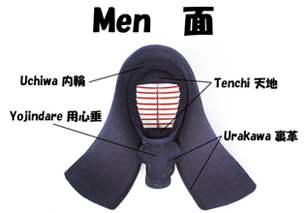
The men protects the face, neck, and shoulders. It consists of a facemask with several horizontal metal bars running the entire width of the face, from the chin to the top of the head. To this is attached a long rectangular thick cloth padding that curves over the top of the head and extends to cover the shoulders. A throat protector is attached to the bottom of the facemask.
|
|
The part above the temple of the head is considered as a point area.
|
 |
 |
Dō (胴 ,どう): Torso protector
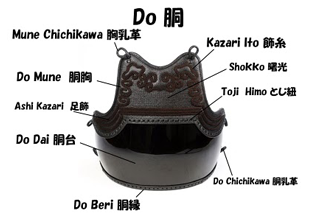
Do is subdivided into Migi-do (right) and Hidari-do (left). In general, Do means the right one (i.e. the right side of the opponent). As opposed to the right Do, the left Do is often described as Gyaku-do, which means the opposite Do.
|
|
KOTE (小手 ,こて): Hand and forearm protectors
The kote are mitten-like gloves. They were designed expressly for kendo. While appearing to be cumbersome, enough mobility is allowed to grip the shinai in a comfortable, powerful, and firm way. In the past kote were often made with fully articulated fingers. This is rarely seen today as there can be a safety issue with snagged fingers. A special heavily padded design known as oni-gote (鬼小手おにごて) are used by some koryu, most notably Itto-ry. The target area is the wrist portion of each kote.
|
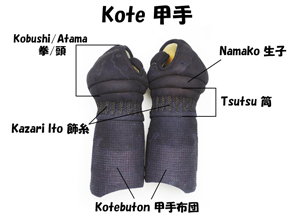 |
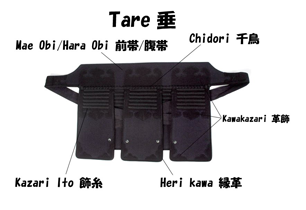 |
TARE (垂れ ,たれ): Leg and groin protector
This part is not considered as a valid point area.
The tare is a thick cloth belt that wraps around the waist and ties under the front flap in front of the groin. Sturdy cloth covered flaps hang from the belt to protect the upper legs and groin. The flaps run along half of the belt's length, which should be positioned over the front half of the body.
|
SHINAI (竹刀 ,しない) Practice sword
Shinai (竹刀 ,しない) is a weapon used for practice and competition in kendo and are meant to represent a Japanese sword. Shinai are also used in other martial arts, but may be styled differently from kendo shinai, and represented with different characters.
The word "shinai" is derived from the verb shinau (撓う ,しなう), meaning "to bend, to flex", and was originally short for shinai-take (flexible bamboo). Shinai is written with the kanji 竹刀, meaning "bamboo sword", and is an irregular kanji reading.
|
In kendo, the majority of students use one shinai. This kendo style has its roots in the tradition of the ittō (一刀 ,いっとう), or one-sword school. However, some kendoka choose to use two shinai, called ni-tō (二刀 ,にとう), a style that has its roots in the two-sword schools of swordsmanship. A ni-to combatant uses a long shinai called the daitō (大刀 ,だいとう), which usually held in the left hand, and a shorter shinai, called the shōtō (小刀 ,しょうとう), which is usually held in the right hand.
|
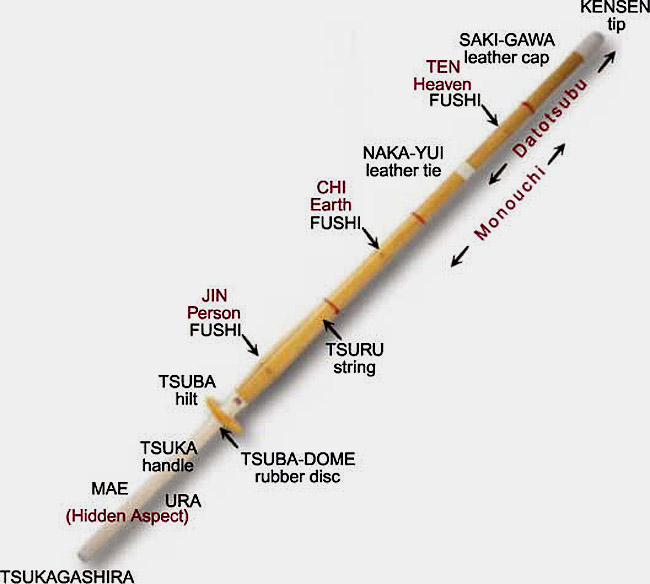 |
The ancestor of the modern kendo shinai is the fukuro-shinai (袋竹刀 ,ふくろしない), which is still in use in koryu kenjitzu. This is a length of bamboo, split multiple times on one end, and covered by a leather sleeve. This explains the name fukuro, which means bag, sack or pouch. Sometimes the more old and rare kanji tō (韜) is used, but has the same meaning as fukuro.
Some schools cover the entire bamboo in the sleeve and add a tsuba, like Kashima Shinden Jikishinkage-ryu does. In Shinkage-ryu, the sleeve is laxquered Kamakura Red, and rather than covering the entire length, is tied off at the non-split end. This particular kind of fukuro-shinai is also called a hikihada (蟇肌 ,ひきはだ), or toad-skin shinai. The name comes from how the leather looks after lacquering; the sleeves are actually made of cow- or horse-hide.
Shinai is the sword for Kendo-ka. It is indispensable to use it carefully as you do with a real sword. Therefore, to step over Shinai or to lean on Shinai is out of the question.
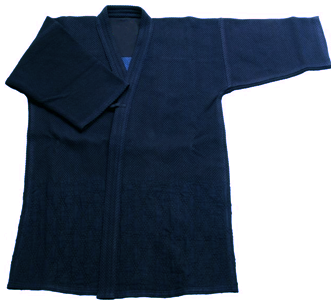 |
Keikogi (稽古着 or 稽古衣) or dōgi (道着)
Keikogi (稽古着 or 稽古衣) or dōgi (道着) is a uniform for training, used in martial arts derived from Japan, or budo. (keiko means practice, gi means dress or clothes). In english, the term keikogi is sometimes referred to simply as the gi, which would be an incorrect use of the word in Japanese. Often keiko is replaced with the name of the Japanese Martial Art being practiced.
|
Hakama (袴)
Hakama (袴) are a type of traditional Japanese clothing. They were originally worn only by men, but today they are worn by both men and women. Hakama are tied at the waist and fall approximately to the ankles. Hakama are worn over a Kimono (Hakamashita).
There are two types of hakama, divided (umanori 馬乗り, "horse-riding" hakama) and undivided (andon bakama 行灯袴). The umanori type have divided legs, similar to trousers. Both these types appear similar. A "mountain" or "field" type of umanori hakama was traditionally worn by field or forest workers. They are looser in the waist and narrower in the leg.
|
Hakama are secured by four straps (himo); two longer himo attached on either side of the front of the garment, and two shorter himo attached on either side of the rear. The rear of the garment has a rigid board-like section, called koshi-ita (腰板), below that is a hakama-dome (袴止め) (a spoon shaped component sometimes referred to as a hera) which is tucked into the obi or himo at the rear, and helps to keep the hakama in place.
|
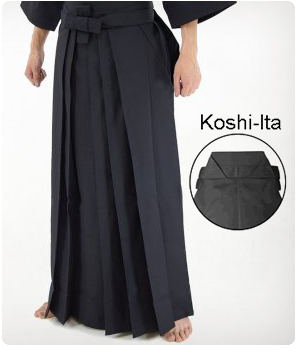 |
Each pleat represents a god of war, namely Take-Mikazuchi-no-Kami and Futsu-Nushi-no-Kami. The Koshi-ita, which gathers the two pleats, represents the god of the sun, Amaterasu-Omikami. As a whole, this represents the concept of Wa (harmony). On the other hand, the five pleats in front represent the five principles which one has to hold, that is, Jin (affection), Gi (righteousness), Rei (courtesy), Chi (wisdom), and Shin (sincerity).
How to Fold the Hakama?
How to tie the Hakama?
