


 tkkim@hotmail.com


Proud Member of :

Canadian Kendo Federation


Interesting Links
Media & Trivia
Muso Shinden Ryu
夢 想 神 伝 流Koryu & Seitei
Koryū (古流 old style) is a Japanese term used to describe Japanese martial arts that predate the Meiji restoration (1868). The term is contrasted with Gendai budo "modern martial arts" which refer to schools developed after the Meiji Restoration.
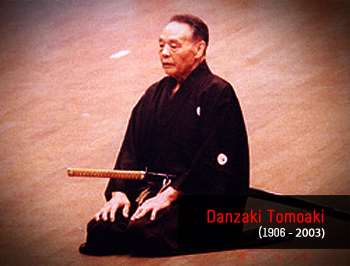
Shidokan's Koryu is Muso Shinden Ryu. Our school traces back to the line of Danzaki Tomoaki Sensei through Fred Okimura Sensei passed on to his direct students Santoso Hanitijo (5th Dan), Robert Miller (5th Dan) and Dean Jolly (5th Dan). Danzaki Sensei was a direct student of Nakayama Hakudō Sensei
At Shidokan, students learn both Koryū and Seitei Iaido (制定). "Seitei Iaido" is the style of the All Japan Kendo Federation (AJKF, Zen Nippon Kendo Renmei or ZNKR). The twelve Seitei iaido forms (seitei-gata) are now standardised for the tuition, promotion and propagation of iaido within the kendo federations around the world. Most serious iaido schools include "seitei" in their curriculum, besides their Koryu.

|

|
|
Muso Shinden Ryu Demo, by Ide Tomota sensei (8th dan Hanshi)
Hakuo Sagawa Sensei |
Hakuo Sagawa Sensei |
Historic Background
Muso Shinden ryu iaido (MSR) is one of the many styles of drawing the Japanese sword descended from Hayashizaki Jinsuke Shigenobu (c.1542 - 1621). Hayashizaki is considered the "founder" of sword-drawing as a form distinct from fighting with swords already drawn.
Muso Shinden iaido descended by way of Tamiya ryu iaijutsu (c.1603), along with Muso Jikiden Eishin ryu and many other styles. The descending line of iaido we are concerned with here was influenced by a series of successive headmasters, including Hasegawa Eishin (c.1716-1736) , Omori Rokusaemon and Hayashi Rokudayu Morimasa. The resulting style at this point, in the 18th century, was referred to as Tosa iai.
It subsequently split into two branches in the 19th century. The Tanimura ha (Tanimura branch), led by Tanimura Kamenojo, became Muso Jikiden Eishin ryu in the beginning of the 20th century, named by headmaster Oe Masamichi (1852- 1927). The Shimamura ha, led by Shimamura Ichisada, became the Muso Shinden ryu under Nakayama Hakudo (1869-1958) around the same time.
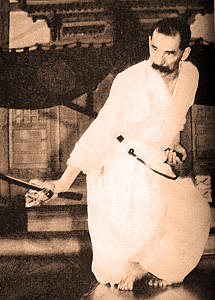
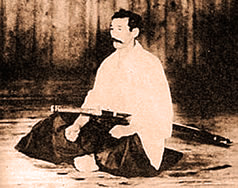
Some suggest Nakayama Hakudo was the “founder” or “inventor” of the style. From the foregoing we can see this is untrue. Nakayama Hakudo reorganized the Shimamura ha and renamed it in keeping with established tradition. He was the last Muso Shinden ryu headmaster. Since then Nakayama’s senior students have become prominent teachers, resulting in some mild variations in the details of some of the kata.
Meaning of the kanji 夢 想 神 伝 流
"Muso Shinden" means “transmission [of] divine vision.” However, we should avoid reading too much into its literal translation. The sounds of both "muso" and "shin" are found throughout the history of sword styles, but they are not always represented by the same characters from one school to another.
The hearer/reader is supposed to pick up the layers of meaning implicit in the similar sounds, as well as reading the characters. There are also traditional aesthetic and spiritual concepts associated with the characters. For example, the character for “shin” is also “kami,” usually translated into English as “god” but entirely different from any Western concept of the divine.
The “divine vision” may refer to Hayashizaki’s vision of the art, or could refer to something else. Therefore, it is difficult to understand this sort of imaginative naming without being familiar with the Japanese language, traditions and some martial arts history. Understanding these less-obvious meanings are closer to understanding the meaning of the name as a whole. Suffice it to say for now that there is more in a name than just its kanji.
Characteristics
|
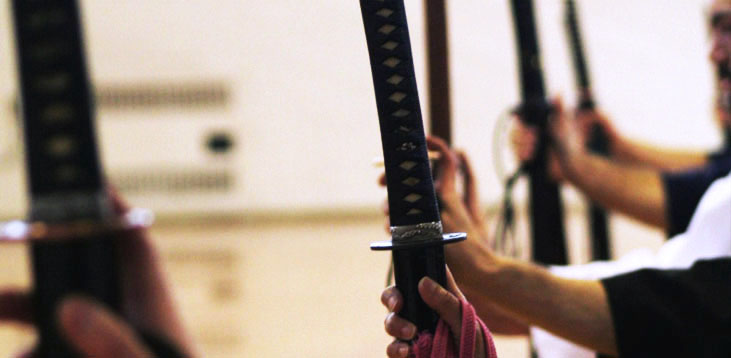
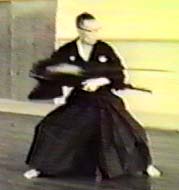
The kata from Musō Shinden-ryū present some differences in their execution from the kata of the same name practiced in its sister art of Musō Jikiden Eishin-ryū. Among the most visible are the manner in which the Furikamuri (raising the sword overhead, more commonly known as furikaburi) and the nōtō (sheathing) are done. Both arts also differ from many other iaijutsu schools in that there is no kiai. FurikaburiAfter striking with one hand, primarily on nukitsuke (cutting as one draws the sword out), the sword is brought to a position about ten centimeters above the left shoulder, blade edge up, and with the point facing backwards. The movement resembles a thrust to the rear. Unlike in Musō Jikiden Eishin-ryū, the sword does not fall off behind the back but always stays over shoulder height. The right hand then raises the sword overhead while the left hand takes its place on the hilt, thus entering in the jōdan stance or kamae. The sword should now be right in the middle line of the body, with the tip raised forty-five degrees upward and your left hand hovering just above your forehead |
NotoIn Musō Shinden-ryū, the sheathing is performed horizontally with the blade outwards. Only when the sword is about two-thirds of the way in the saya is the edge turned to face upwards. The blade and saya should cross your center line at a forty-five degree angle while sheathing. |
 |
Technical elements of Muso Shinden series
Muso Shinden consists of three parts described below: the first, second levels, and the secret level.
The First Level: Shoden (初伝)
"Shoden", which can be translated as the "entry-transmission", consists of the kata of Ōmori-ryū iaijutsu plus one kata variation exclusive to Musō Shinden-ryū. All kata(s) start from the seiza sitting posture, except the 10th kata which starts from a standing stance.
Shoden level has been included in Musō Shinden-ryū as the entry level. This series of kata was made the first to be learned when the 17th headmaster of the Tanimura branch, Ōe Masamichi, reorganized and rationalized the curriculum of Hasegawa Eishin-ryū at the start of the 20th century.
It seems there is no relationship with the original Shigenobu style
The naming of forms is too sophisticated (perhaps influenced by Chinese literature or philosophy). This means these forms are not quite old. It could be said that these forms were a mere formalization, or an invention for beginners training.
- Shoattō (初発刀)
- Satō (左刀)
- Utō (右刀)
- Ataritō (当刀)
- Inyōshintai (陰陽進退)
- Ryūtō (流刀)
- Juntō (順刀)
- Gyakutō (逆刀)
- Seichutō (勢中刀)
- Korantō (虎乱刀)
- Gyaku Inyo Shintai (Inyōshintai Kaewaza) (陰陽進退替業)
- Battō (抜刀)
The Middle Level: Chūden (中伝)
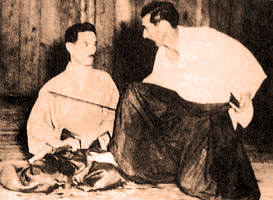
"Chūden" can be translated as the "middle-transmission" and consists of ten techniques from Hasegawa Eishin-ryū. Hence, this level is also called the Hidenobu (Eishin) style.
This series of kata is executed from the tatehiza sitting position, except the last form "Nukiuchi" which starts from "Seiza". In contrast to the first series of kata, the enemy is considered to be sitting very close and thus the primary goal of the chūden techniques is to create proper cutting distance (kirima) by stepping back instead of forward.
Ōe Masamichi apparently developed a method to execute all ten techniques in a row in what he called haya-nuki or "quick draw". Two version exists. First, you can use two hands, that is you can use both the left and right hand to execute the movements, just as in the normal execution. The second method involves drawing the sword with only the right hand, as if you were on a horse. This kind of practice is not done in formal presentations
- Yokogumo (横雲) Horizontal Clouds
- Toraissoku (虎一足) Tiger's One Step
- Inazuma (稲妻) Thunderbolt
- Ukigumo (浮雲) Floating Clouds
- Yamaoroshi (山颪) Downhill Storm
- Iwanami (岩浪) Rock and Wave
- Urokogaeshi (鱗返) Scaling Off
- Namigaeshi (浪返) Backwash
- Takiotoshi (滝落) Waterfall
- Nukiuchi (抜打) Sudden Attack. It's also called Joi-uti (punishment ordered by the boss). Considered by some, a very common assassinating technique.
|
The Secret Level: Okuden (奥伝)It is called "Oku Iai" or "Okuden". The word "Okuden" can be translated as the "inner-transmission" Considered as a collection of real assasination techniques.
The name "Oku" implies that at the beginning, these forms were confidentially inherited and have never been exposed to people outside of the school.
Nowadays, these forms considered as "original", and have been treated as sacred ones.
|
Sitting Forms
- Kasumi The name means "mist". One man sitting in front of you.
- Sunegakoi Knee Covering.
- Sihogiri Attacking the Four Sides (all around).
- Tozume Two men sitting in front of you. Attack one bye one.
- Towaki One is behind and another is in front of you. First attack the behind and then front.
- Tanashita Hide yourself under the shelf, crawl out, then attack.
- Ryozume Similar to Tanashita. Not strike but stab.
- Torabashiri Tiger Run. Stand up and run to the front one, then run backward, strike again.
Standing Forms
These forms are very exciting and realistic.
- Yukidure Going Side by Side. (Escort) There are two men in the both side you, walking together. Maybe you are arrested by them, trying to escape.
- Turedati Going Together. (Escort) There are one in front right and the other back left.
- Somakuri Continuous Atack. Wind sword around to smash surrounding enemies.
- Sodome Attack One After Another. (One handed cuts) Enemies are in a row coming towards through a relatively narrow path.
- Shinobu Secret Attack. It is also called Yami-uti (Attack in the Darkness). Oh! how unfair this technique is !? You approach your victim from his behind in the dark, slowly, quietly, click on the road the tip of the sword to divert his attention, then strike from the opposite side.
- Yukichigai Encounter Attack. There are two persons coming towards in a row, when you reach between them, first stab the behind, then hit the front.
- Sodesurigaeshi Pushing Through the Crowd. You find your target beyond the crowd on the street. Draw out the sword first, pushing your way through the crowd, then reach and strike him.
- Moniri Entering Through the Gate. Walk toward the gate, lower yourself, stab the first coming one, then strike others.
- Kabezoi By the Wall. Beyond the opponent there is a wall preventing from swinging the sword around.
- Ukenagashi Receive and redirect the opponent's attack.
- Itomagoi 1 Farewell 1. While saying good bye, suddenly draw out your sword, then swing it vertically onto the opponent's head, smash at one stroke, before he notices what happens. Farewells are supposed to be a modification of Nukiuti. Farewell 1 bow slightly.
- Itomagoi 2 Farewell 2 bow more deeply
- Itomagoi 3 Farewell 3 bow quite deeply, it will hide your sword-drawing action from the opponent.
